
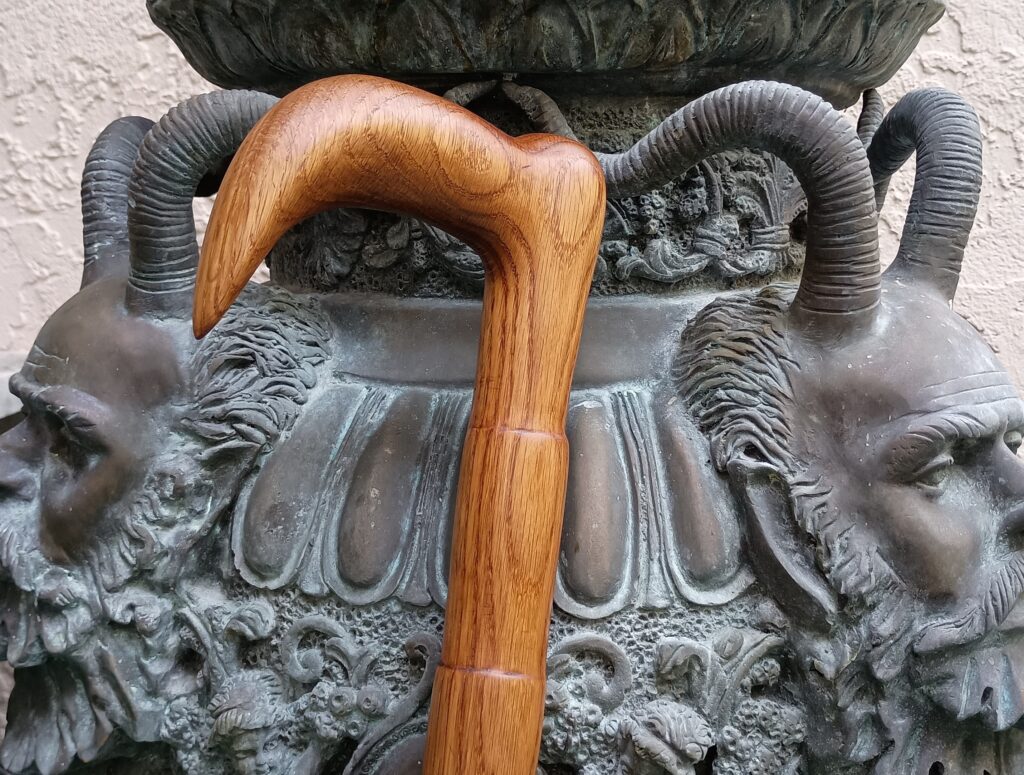
Canes, particularly self-defense canes, have always had an appeal to me, with their numerous purposes beyond compensating infirmities. I haven’t studied the history of canes, though they certainly appear throughout the ages, in the form of style embellishments, status symbols, extra legs and weapons. From sacred scepters to the English knob and derby, they’ve stabilized gentlemen and destabilized hooligans, imparted character to both genders, and I suppose even given companionship to lonely persons.
Times change and trusty twigs aren’t much in fashion anymore, but bad knees, weak hips and general malaise guarantee a timeless utility for the stalwart stick. Although they stand out, perhaps a bit more now than in bygone eras, they can still serve the universally valuable purpose of self defense while providing extra support in a relatively low profile manner.
I’ve recently entered a cane-crafting phase, having several ideal pieces of various hardwoods that are suitable for single-piece, solid wood canes. I’ve not yet attempted to make a two-piece cane, but may at some point, somewhat depending on the success and reception of my single piece versions.
A single piece cane poses some challenges, notably the grain orientation. The length of most canes is aligned with the grain of the wood, and this is an important consideration with the handle portion. As pressure is applied parallel to the grain, it can have a splitting effect, specifically as it deviates from the surrounding material underneath, ie the shaft. The image below shows the broken handle of a cumaru cane, which split parallel to the grain as pressure was applied downward:
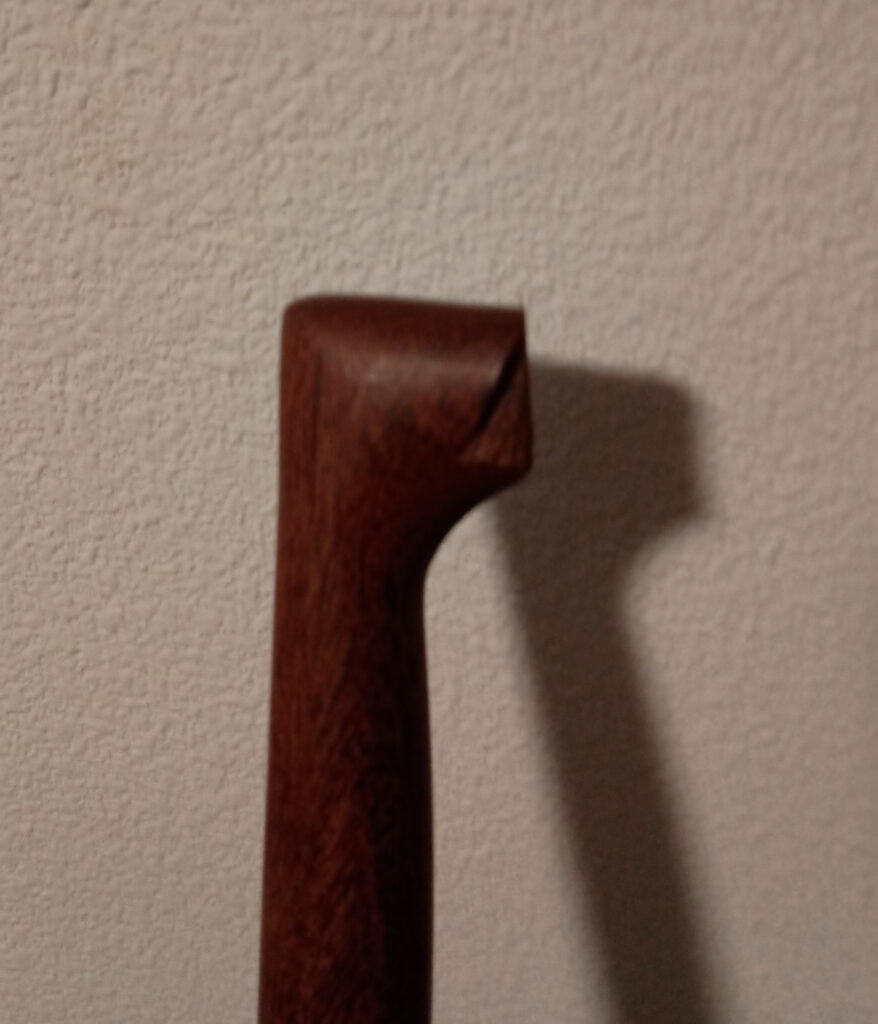
Cumaru is one of the toughest woods on Earth when compressed or opposed perpendicular to its grain. But it is vulnerable to splitting, more so than many woods of inferior strength. To overcome this, the handles need to be ample enough to resist this, and therefore require more bulk than pure elegance permits. A two piece cane would intrinsically avoid this problem. But I am only making single piece canes, for now.
Below is a single piece, solid wood self-defense cane made of white oak. While white oak is not an ideal wood for this type of cane, it is both more robust against splitting and adequately strong, especially when girthy enough.
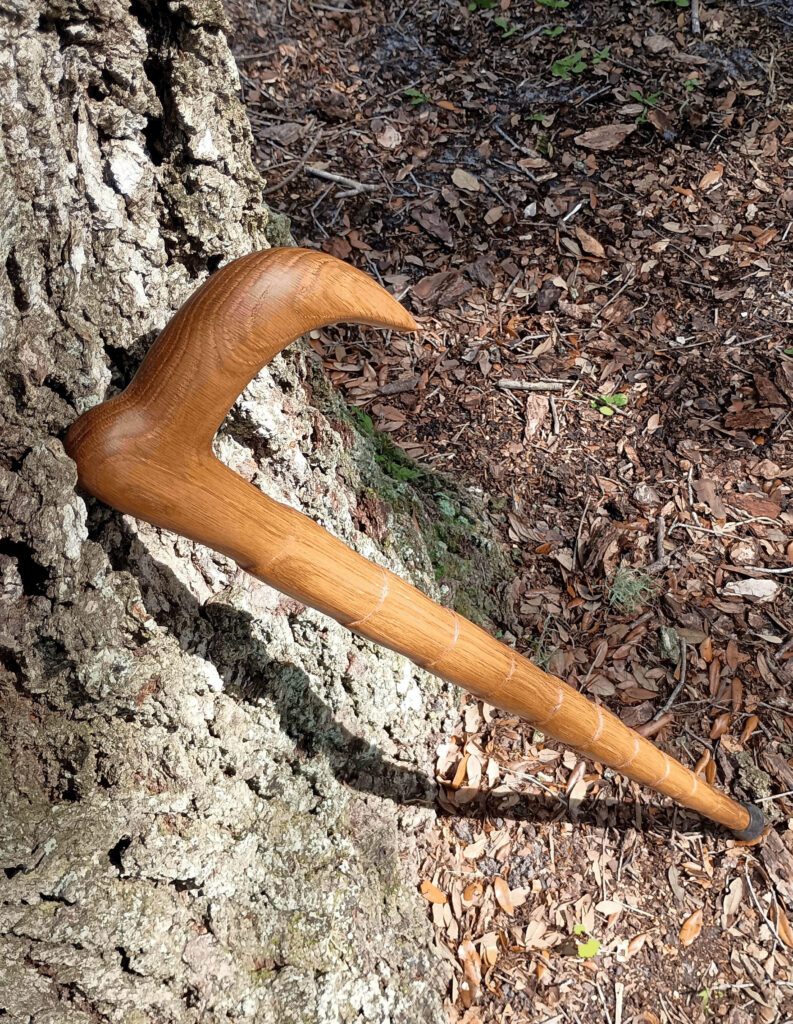
The style or design is a product of what was perhaps an assumption or misunderstanding. When carrying an object with self-defense in mind, there are legal concerns. I had heard the fellow from Cane Masters mention in one of his videos that canes of a certain profile or style were universally legal to carry throughout the United States. According to his video, the user of such canes is protected from harassment and, generally, cannot be harassed or interrogated about the use of their cane. This, if true, is important, and I’ve been attempting to design my canes in accordance with this in mind. And this is why they are oddly shaped and less elegant than would be a cane crafted free of such constraints.
A cursory bit of research on the subject didn’t yield any unambiguous or explicit laws that make any of this perfectly clear. But I said cursory, not comprehensive. What I found was the following:
Americans with Disabilities Act (ADA)
The ADA (42 U.S.C. § 12101 et seq.) is a comprehensive federal civil rights law that prohibits discrimination based on disability, including in public accommodations, government services, and transportation
Under the ADA, individuals with disabilities are generally permitted to use mobility aids such as canes, walkers, and wheelchairs in public spaces. The law makes it difficult for law enforcement or others to question a person’s need for a cane or walking stick, as doing so could constitute discrimination
The ADA does not, however, specifically address canes as weapons, nor does it provide blanket immunity from harassment or police inquiry if the cane is used or intended as a weapon.
I am content with the above and am mostly interested in producing a handful of nice canes with the dual function of support and self defense. While admittedly critical for anyone wanting to uphold their dignity in life and preserve their rights, legalese is a something I detest, along with the fractal infinity of slippery interpretations that comprise it.
I am making canes, in loose accordance with my interpretations of these laws, thus my canes are embedded (or tainted) by design, with a pinch of legalese.
Below are two self-defense canes; one made of solid ipe and the other of cumaru. In almost every way, I prefer the cumaru version, but the ipe version is quite a cane.
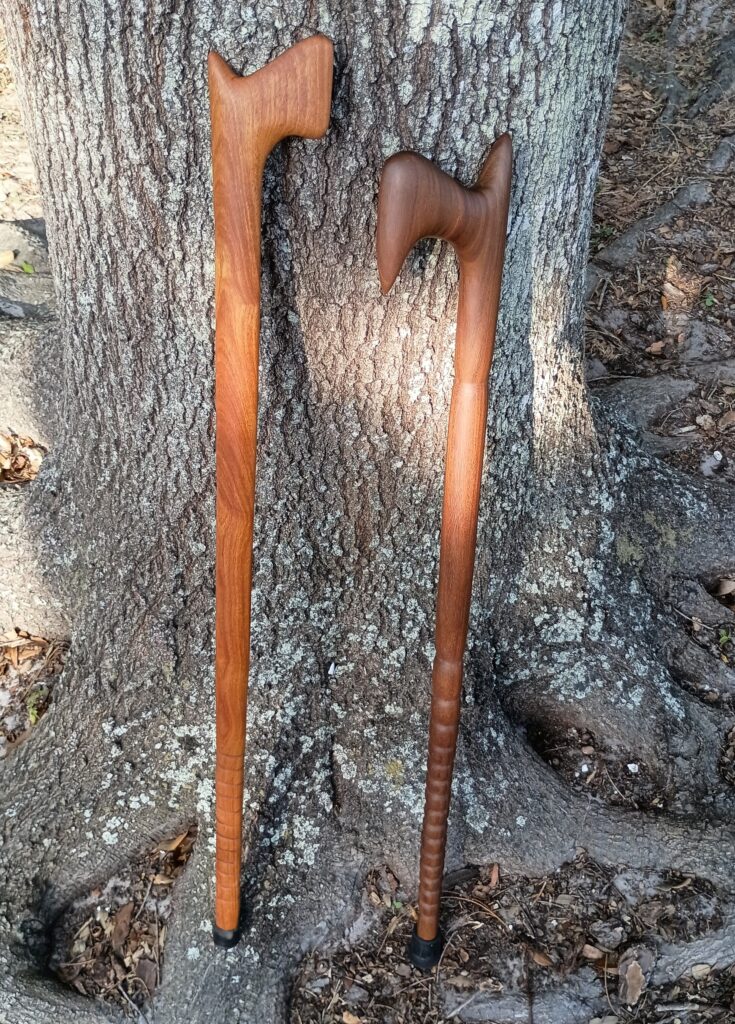
Ipe can be beautiful, but is also treacherous, in more than one way. It is highly vulnerable to parallel grain splitting. One piece can be virtually indestructible and the other as fragile as glass. It’s wonderfully heavy and dense, finishing to a smooth, nice deep brown. Its splinters are among the worst of any wood and cause instant suffering. It is laden with silica, posing a threat to one’s lungs equal to asbestos. It quickly dulls even carbide bits and blades. And it’s an irritant too. So one might wonder why the hell anyone would touch it. I rarely do, but had an enormous board of it, perfect for a single piece self-defense cane.
Cumaru, while not as visually compelling as ipe, bears a slightly lower rating on the janka scale, but is generally a superior wood in regard to toughness. It’s a brutally tough wood, and far from ugly. It too contains silica, but not as much as ipe. In my opinion, there are few available woods that would offer better attributes for a cane that may be subject to abuse.
The image below is a closeup of the knurling for the grips. My canes are mostly intended to be gripped from the far end (or shoe end) when used for defensive applications. They are hand filed with a rasp, and rounded as I go. This is a time consuming process that would be much less onerous on a lathe, but it is not so much the filing that takes the most time — it’s the sanding.
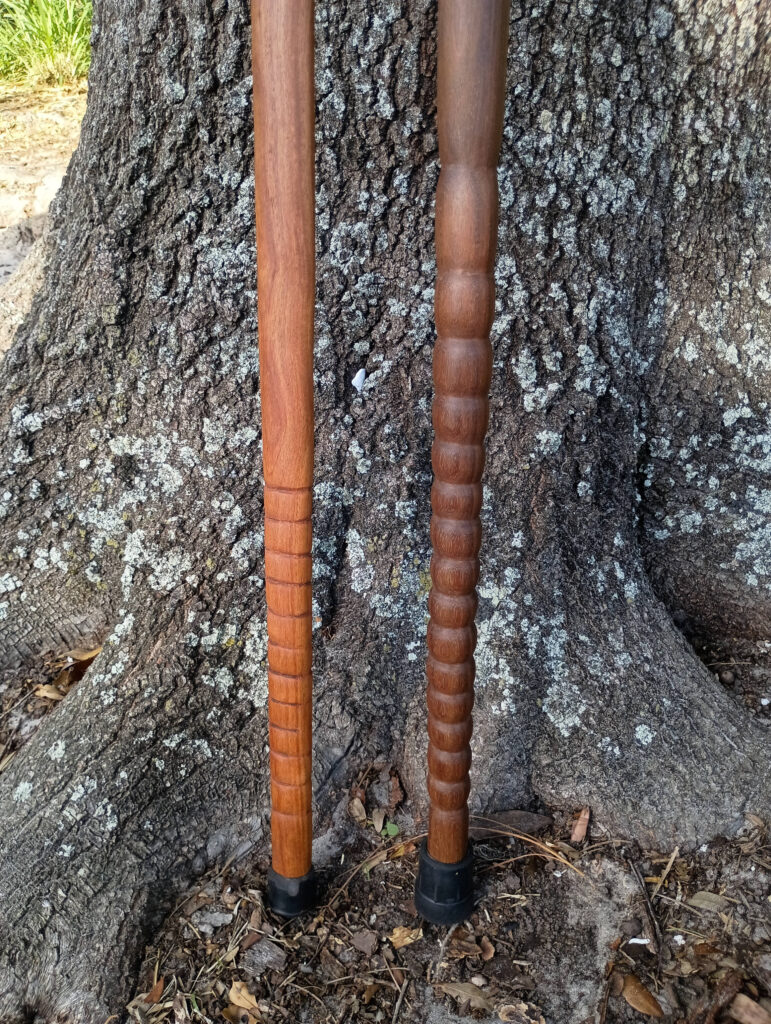
The ipe version is uniformly rounded but for the handle, which has a chiseled edge, resembling an axe. The cumaru version is oval, having a a sort of double edge that begins just above the knurling and almost into the handle. The handle is also slightly edged. This chiselled edge imparts a a very different result upon a stricken object, focusing the force of the blow into minimal surface area while backed by a lot of mass. Whether clearing a bit of brush or hewing the legs of rabid beasts, it maximizes efficacy in two directions at the cost of reducing it elsewhere. It’s my favorite cane yet, having both speed and mass, it’s a low-profile, highly effective self-defense cane that when at peace, will serve its user with dependable stability while remaining friendly to any eyes upon it.
The ipe cane is also quite a formidable and nice cane. It is best suited for a large or stout user and would require strength to use in a defensive manner. And all three, of oak, ipe and cumaru, will last lifetimes on idle. In action, I can only surmise that they should hold up well enough, but I’d place the most confidence in the cumaru.